Friday, August 27, 2010

Denali ... "The High One"

Mt. McKinley, 20320 feet tall, is America's highest peak!

Between Talkeetna and the entrance to Denali National Park, The Milepost noted 8 different places along Park Highway where there is "a view of Mount McKinley (weather permitting)". The key works are "weather permitting".  The day we drove that route it was overcast and we could only see the lower mountains.  How frustrating!

In reading The Milepost I did learn that Denali means "the high one" in the Native language.

Free courtesy buses take you 6 miles into the park.

We stayed in Riley Camp Ground, near the park entrance for a few days in order to get the lay-of-the-land. While we were there we went to the Visitor Center to watch the video about the park, listen to a   Ranger's lecture on wolves, and take advantage of their wonderful displays of wildlife. One day we took
the courtesy shuttle bus out to Savage River to do some easy hiking along the river trail.
The Savage River.
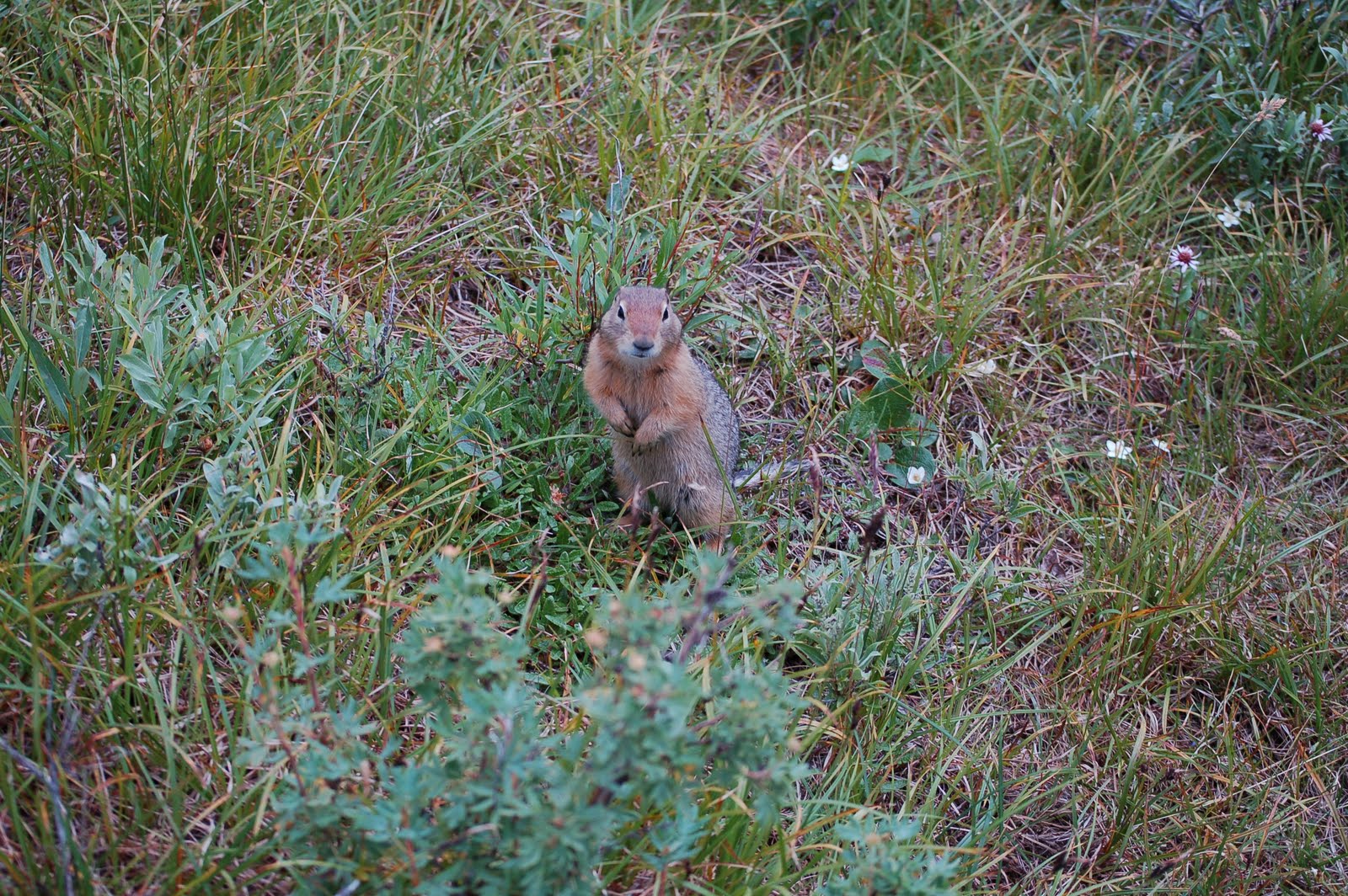
The Arctic ground squirrel..... the guy at the bottom of the food chain!

Savage River is six miles inside the park and anyone going further must have a permit or be on a tour bus. The trail along the river was pretty flat, and we thought it was a good one for David's first hike since his operation. The only wildlife we saw were little Arctic ground squirrels.  They reminded me of praire dogs.  Later I learned that they are about 2,000 calories each.... a good lunch for everything bigger than they are.


Rather than catch the bus back from there, we decided to walk along the road to the next shuttle stop.  This enabled us to soak in the quiet and the majesty of the panoramic views.  Along the way we scanned the landscape for animals and I was excited when I spotted a HUGH bull moose!  Later David saw a pygmy owl.  Both "finds" were exciting.

A "moose pond" near Teklanika Campground...but no moose.

After four days we moved further inside the park to Teklanika Campground.  One day we took the shuttle bus to Wonder Lake, which is almost the end of the park highway. It was an overcast day and we got to see many animals. We saw two grizzly moms with twins.  They ignored us because they were busy eating soapberries.


Most of the animals were far from the road and difficult to photograph, so I usually just used my binoculars.  And now, since my computer is on the fritz, I am writing this Blog using pictures that were taken by David.

Dall sheep along the park highway.

Caribou!

The second day at Teklanika the sun was out and there was a steady breeze.  We went out again with the shuttle bus and stopped at Eielson Visitor Center for some wonderful views of Mt. McKinley.  On the way back to the campsite we got off the bus again in order to walk along the road in silence. It is impossible to grasp the grandeur of the park, but at least we get a feel of it when we are out there alone

 Denali from the park road.

When we were camping at Riley Campground there was a red fox that wandered by every day, and when we were camping in Teklanika River Campground there was a lynx that made its rounds each night. Not the usual campsite visitors.
In Teklanika we were reminded of the movie "Into the Wild' because it was the Teklanika River that prevented Chris McCandless from leaving his bus in the wilderness, and thus caused his death by starvation. After being here we want to see that movie again.  

This is wild and wooly country and it is good that Denali National Park and Preserve has been established to preserve the wildness and naturalness. It has been only slightly touched by our modern times.  Denali was originally begun as a game sanctuary to protect wildlife and now its 324,420 acres hold a bit of nature in its pristine state, for us and for generations to come.

Unidentified wild thing.


Saturday, August 14, 2010

Talkeetna - Rest and Rebound

David, 24 hours after our 3 am ER visit! 


Since this Blog is a diary of sorts, our experience in Wasilla must be included. I woke up at 3:00 am one Saturday morning to find David in the bathroom feeling sick to his stomach. When he told me that he was also having chest "pressure" and his arms felt "weak" we recognized the classic signs of a heart attack and... we were off! Our GPS located the nearest hospital which turned out to be the Wat-Su Valley Regional Medical Center, thankfully only 5 miles away.

The magic words in an emergency room are "chest pain".  Within 15 minutes David had IV's in both arms, an EKG was taken, blood drawn, and 3 nitroglycerin tablets placed under his tongue.  He was quickly stabilized and then flown by helicopter to Providence Hospital in Archorage.  With the help of our GPS, I followed him in the RV. By 6:30 am I joined David in the cardiac ICU while he waited to see a cardiologist.  

A cardiac catheterization indicated the need for 2 stents, and in less than 12 hours David was feeling A-OK with his new and improved body parts. Oh, the wonders of modern medicine!!

Behind the hospital there is an RV parking lot equipped with electrical outlets. I stayed there during David's hospitalization and we stayed there the day he was discharged so we could decide our next move. We discussed how we had signed up for this crazy life-style, and since he felt fine, we decided to head to Denali National Park as planned.... but slowly.

 Talkeetna .... Authentically Alaskan.

Located at the confluence of the Talkeetna and Susitna Rivers, Talkeetna began as a trading post in 1896, and grew as a riverboat supply base following the Susitna River gold rush in 1910. The population boomed during the construction of the Alaska Rail Road, and then has declined to today's count of 849 .

We heard about Talkeetna when we told people we were on our way to Denali National Park.  We were told over and over again, that the best view of Mt McKinley was from the shore of the Talkeetna River.

      Mt. McKinley under the clouds beyond the Talkeetna River.

Although we were there for three days and never saw the mountain, we still got the feel of it because Talkeetna is McKinley's mountain town.  Climbers from all over the world use this little village as their jumping off point.  We saw Tibetan prayer flags, Korean banners, historic buildings, old log cabins, companies offering rafting trips, fishing trips, flightseeing trips, and glacier landings, grizzled locals, artisans, and lots of tourists like us, just wandering up and down Main Street, taking in the spirit of the place.

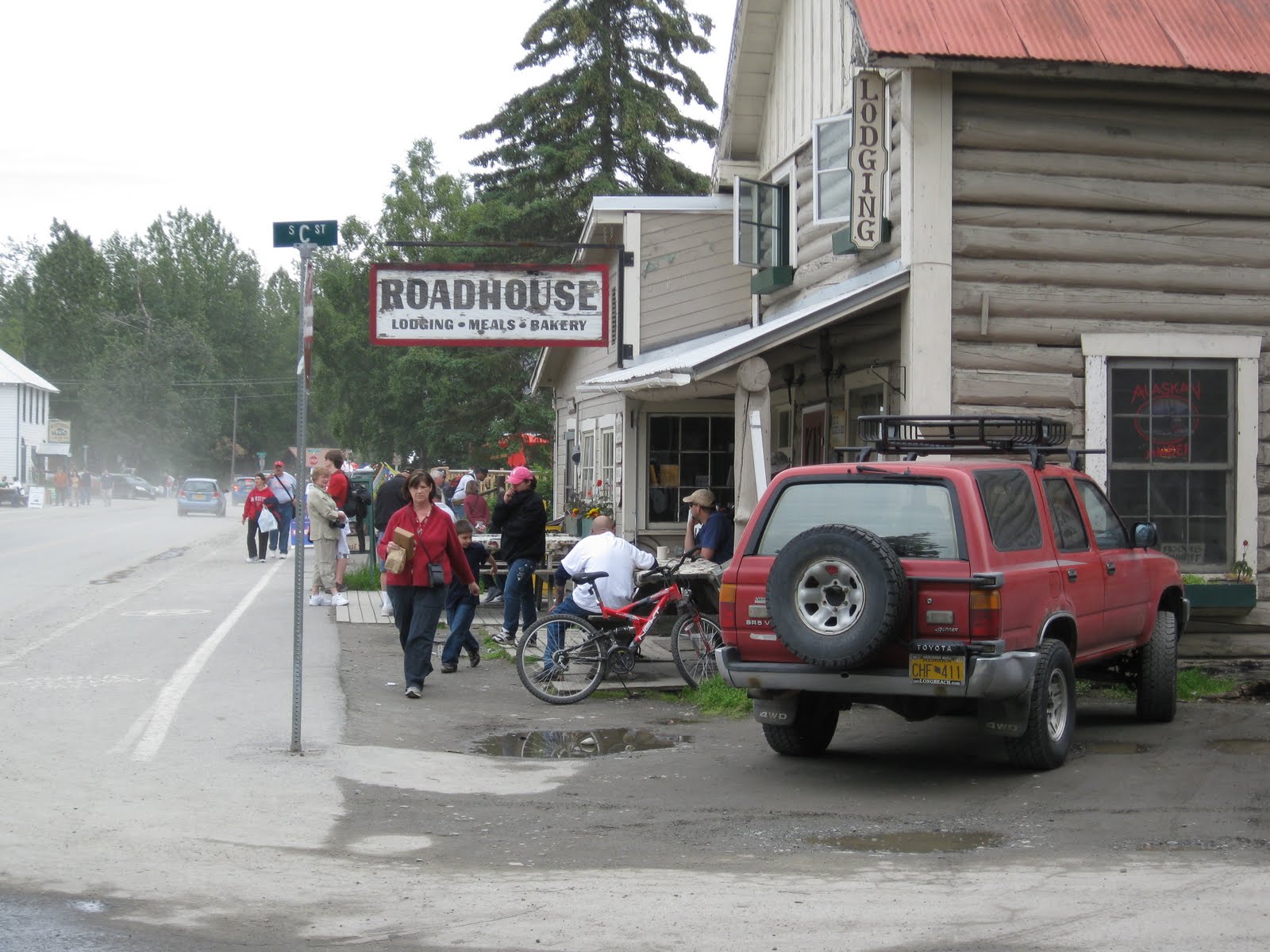
One of the most interesting buildings in town is the Talkeetna Roadhouse. In the Bearfoot Travel Guide I read; "In Alaska's mining and trapping days, every town, every river crossing, and every 10 miles on the trail featured a roadhouse, or a lodge, or a small cabin, or even a tent, where travelers could find food, shelter and companionship."
The Roadhouse was initially a supply station, but meals were served there by 1918 and it earned the official title of roadhouse when it got fixed up with a cafe, bedrooms and indoor plumbing in the 1940's. 

         The Roadhouse .... delicious homemade food in a low key setting.

Another unique building is Nagley's General Store. Mr. Nagley followed the early gold miners and trappers and he opened this store in 1921 at Susitna Landing. When the people moved, he did too.  He disassembled and moved his store twice, by river barge.  Eventually he rolled his store down main street Talkeetna on logs, stopping at night to conduct store business! Mr. Nagley accepted gold and furs from the local trappers and miners, and the owner still does today.  At Nagley's you can buy everything from canned goods and bulk items to bug spray and ice cream!

 Historic Nagley's General Store.

Between 1898 and the 1920's, there was a lot speculation about the need to build railways throughout Alaska in order to carry its resources to market.  Most of them were never built, and some tracks that were laid down didn't last long.  I heard that you can still see abandoned trains in the middle of the tundra near Nome! 

Alaska now has only two railroads, The White Pass & Yukon and The Alaska Railroad.  Talkeetna was isolated from the road system for many years, but when the Alaska Railroad was built it ran right through Talkeetna. 

The Alaska Railroad, the lifeline of the interior.

Prior to 1917 the best method of reaching Talkeetna from the south was by steamer or stern-wheeler up the Susitna River, a journey of over 100 miles. Now the cruise line passengers come up from Seward by rail, and then continue up to Denali National Park.
Population centers have grown up along this railbelt and will probably continue to thrive  as long as there are enough of us who are captivated by the history, beauty and adventure of Alaska. 

I think this is the only state that is often written with an exclamation point after its name.  Alaska!

Thursday, August 5, 2010

The Iditarod Trail

Iditarod Trail Race Headquarters in Wasilla, AK.

Parts of the Iditarod Trail go back thousands of years to trade routes used by Alaska Natives.  At the turn of the 20th century transportion between boom towns like Nome, Fairbanks and Valdez relied on river and ocean steamers in the summer and sled dog teams in the winter.  In 1908 the Alaska Road Commission surveyed a trail from Seward to Nome to replace the route from Valdez. Colonel Walter Goodwin and his team measured the distance from Seward to Nome by attaching a cyclometer to his dogsled! This trail was 400 miles shorter than the trail starting at Valdez.

The Iditarod National Historic Trail from Seward to Nome.

After the discovery of gold in the Iditarod country on Christmas Day in 1908, the trail was cleared and from then to the middle 1920's thousands of people and tons of mail, equipment, supplies and gold went over the trail between Seward and Nome.

The goldfields around Iditarod became the fourth most productive district in all of Alaska.  By the winter of 1911, "gold-train" sleddog teams packed with a half ton of gold would make the 3-week run from Iditarod to Seward. It is reported that Wells Fargo dog teams carried over 1,000 pounds of gold to Seward in 37 days. Over 65 tons of gold, or $1.77 billion dollars at today's value, was taken out of the Iditarod district ....  and most of it was taken out by dogsled! 

Joe Redington, Sr., "Father of the Iditarod".

Most of the Trail fell into disuse in the late 1920's as air traffic increased and gold mining decreased. Forest and tundra reclaimed the Iditarod Trail for almost a half a century. Then in 1973 some Alaskans, led by Joe Redington, Sr., reopened the routes and there was renewed interest in the old trail. In order to draw attention to the role dogs played in Alaska's history, Joe and his friends created an epic sled dog race from Anchorage to Nome following the route of the historic Iditarod Trail. This race ultimately revived dog mushing in Alaska, and it is now recognized as Alaska's official sport.

A sled dog "van".
This guy is missing out on the fun.

Twenty-two mushers successfully completed the first race in 1973, with the winner traveling the 1,000-mile distance in just over 20 days. The video explained that the first races had only 3-4 tough competitors, but there are 20-30 these days, and over 70 teams competing. The first race took over 20 days, and last year Lance Macky won The Iditarod for the fourth year in a row with a time of less ten hours! That finishing time was reduced by the advent carbon framed sleds and the advanced breeding of race dogs.

I was interested in the fact that Libby Riddles was the first woman to win the race, in 1985, and for the next three years the title was taken by another woman, Susan Butcher Manley. 

After David and I had toured the Race Headquarters and seen the memorabilia displays and photographs dating back to the first run, we couldn't resist giving it a try. 


This is part of the trail around the Headquarters.

We were seated in a "wheeled sled" with a team of eight sled dogs and our "musher" behind us.  They took us for a little ride through the surrounding woods for a fee of $10.00 each. We figured we were paying by the yard rather than by the mile, but where else could we get an experience like this?!

"HAW GEE!"

We were surprised that "our" dog team looked rather small and a little skinny. However, today's long-distance racing sled dogs are relatively small and sleek compared to the earlier breeds.  Because the racing loads are minimal, the smaller dogs have gotten more popular.


This fella is waiting for his turn to run.

From Alaska Geographic's publication of Iditarod, I learned that "the demand for dogs and sleds skyrocketed with the gold rushes to Alaska....  During one of the big rushes it was said that no stray dogs could be found on the streets of Seattle, having all been rounded up and shipped to Alaska.  Malemutes, huskies, and other breeds were mixed to haul freight and passengers."

While traveling in Alaska I have noticed signs for trailheads and seen trails along the side of the road that could be dog sled trails. There are networks of trails on the outskirts of many communities. In Soldotna I saw a sign for Peninsula Sled Dog and Racing and I hiked to the trail head just to check it out.  I found a kiosk there, with a map showing the various trail options ranging from 3-14 miles, and I got to see how the trail looks as it leads into the woods. Many of these trails are multi-use trails and shared with bikers in the summer and snowmobilers in the winter.


Trail head sign.

Kiosk showing the trail options from here.

The trail leading out into the woods.

We have heard stories of dog kennel owners feeding their dogs dried salmon.  That was even mentioned in James A. Michener's Alaska. Recently I read a bit of trivia on a restaurant menu that claimed that beaver is a favorite food mushers feed sled dogs during long distance races because it contains 34.9 grams of protien in 100 grams of meat. Maybe dogsledding saves gas.... but it is not free.

Our fee for the ride paid for some of the dog food.

In the Headquarters, David and I watched a very interesting and beautiful video of the 2009 Iditarod Race. It gave us a good idea of the challenges of the race.  The trail goes through forests, over rivers, across mountain passes and along the windy coast of the Bering Sea.  There are strict rules and check-in points that help keep it safe for the mushers and their dogs.  The video stressed the bond that is created between the owner and the dogs, and how crucial that is during a long distance race.  Also, it stressed the importance of the breeding of the dogs and how each kennel keeps accurate breeding records to improve their future racing dogs.  

A Siberian Husky.

Racing dogs of the future.

Here's to the future of dog sled racing! This is a unique sport that definitely caught my interest. I just bought a copy of "Race Across Alaska ... First woman to win the Iditarod tells her story" written by Libby Riddles and Tim Jones.

I agree with Joe Redington, Sr., The Iditarod helps to keep alive the history of Alaska and I am eager to relive Libby's experience on the trail in 1985! 

Saturday, July 31, 2010

Kenai - A Village with a Past, a City with a Future

A Village with a Past, a City with a Future.

The city logo says it all..... the Russian influence, the fishing, the oil drilling out in the Cook Inlet, and the beautiful volcanos of Mt. Redoubt and Mt. Iliamna, 51 miles away across the Inlet.

The Kenai convention and visitors bureau gave me a good summary of the history of the town: "The first people known to have settled in this area were the Riverine Kachemak, who occupied the Kenai and the Kasilof River areas from about 1000 B.C. to about 1000 A.D.  Following the Riverine Kachemak, the Athabaskan speaking Dena'ina people came to the area, and remain here today as the modern Kenaitze.

"The Russian occupation of Kenai and Kasilof  led to the Battle of Kenai in 1797.  The Dena'ina defeated the Russians, and held the territory until the United States purchased Alaska in 1867.  Only a few Russian fur traders remained in the area.  In 1863, a small pox epidemic extinguished half the Dena'ina population.  The people adopted a version of Russian Orthodoxy that included many traditional beliefs as a way to cope with the tragedy.  In 1918, the influenza pandemic brought further losses to the Dena'ina, and many people from villages that were growing ever smaller moved to Kenai.

"In 1912 the first Libby cannery was built and commercial fisheries became the anchor industry of Kenai.  In 1959 the Kenai gas field was discovered and Cook Inlet became the oil capital of Alaska.  The discovery of oil and gas made the idea of statehood more attractive to the Federal Government and in 1959, Congress granted statehood to Alaska. "

The mouth of the Kenai River as it flows into Cook Inlet.

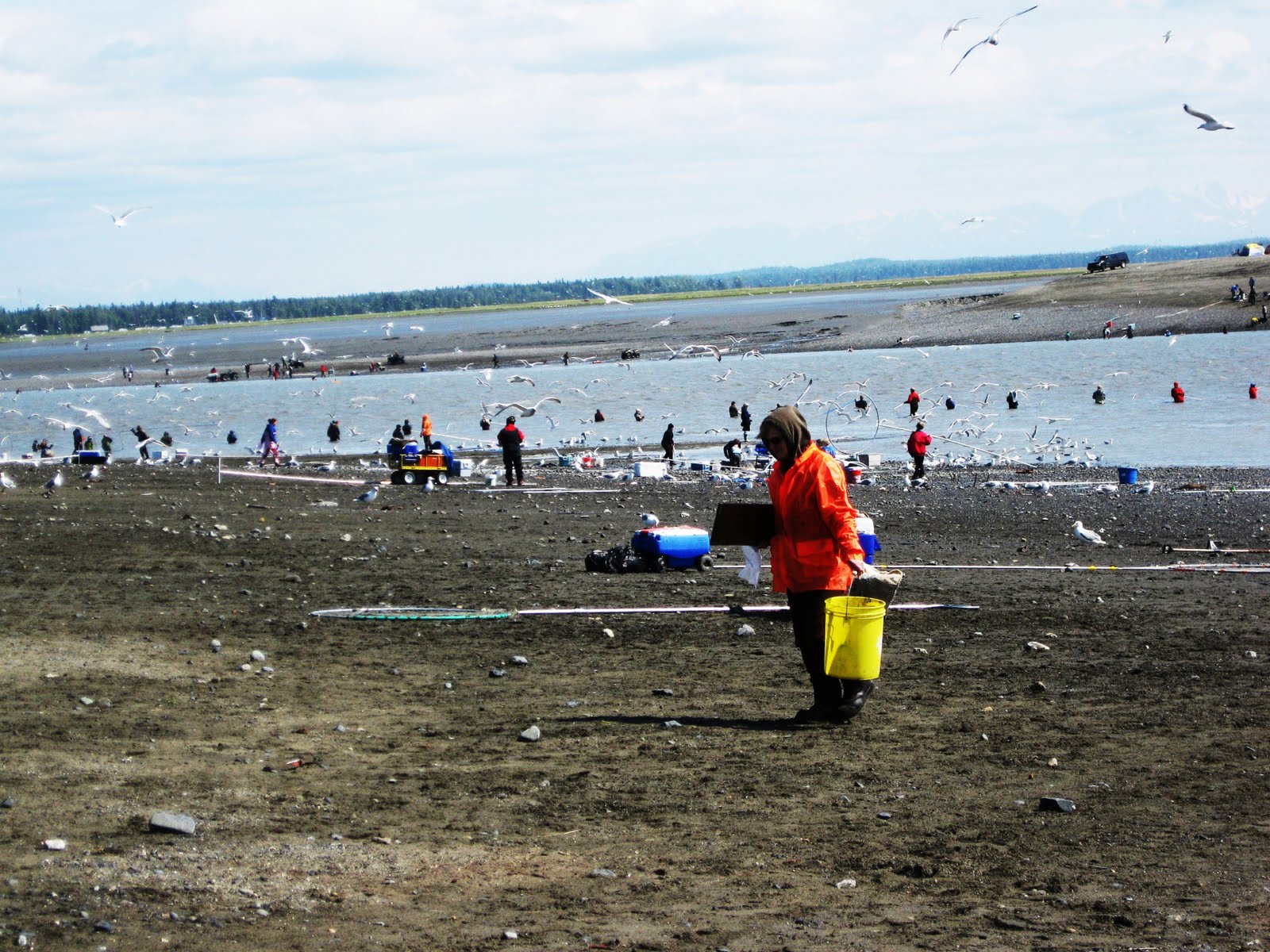
Mid-July marks the beginning of dipnetting season in Alaska.  Dipnetting is a popular way for Alaskans to fill their freezers with fresh salmon for the winter.  Dipnetting is open to Alaska residents only, so for us it was a spectator sport!

Scenes from the beach!
Many of the fishermen camped along the beach.  To dipnet here, anglers stand in the mouth of the river holding large nets with long handles.  When a fish swims into the net, they lift and twist the net to catch the fish. The fishermen cleaned their fish in the river and the gulls were ready to feast on what was left behind. This fishing frenzy is a sight not to be missed!

A man with a fish in his net.

Alaska has "personal use" laws for its residents which regulate their taking of fish, shellfish or aquatic plants for consumption as food or use as bait by an individual or his immediate family.  In the Kenai River, the yearly limit for dipnetting is 25 salmon for the head of the household and 10 more salmon for each additional household member.  In Soldotna we met a young man who catches 75 salmon each year by dipnetting.  His only complaint was the length of time it took him to clean them all!  Of course these same people can also go salmon fishing and get their limit everyday until the fishing season ends.

By law, a person may not possess salmon taken under a personal use fishing permit unless both tips of the tail fin have been immediately removed.  That means before the fish are put into the ice coolers that stand at the ready.  This law prevents the sale of these fish and protects the commerical fishermen's livelihood.

Fishing frenzy.

The fishermen cleaned the fish in the river and the gulls were ready to feast on what was left behind.

Nature's beachcombers.

When we were there the tide was going out so many fish parts which had been thrown into the river earlier were now strewn around on the beach as the tide receded.  There were fish parts and skeletons all over and we had to watch where we walked.

Fireweed was in bloom on the bluff.

After our beach experience we walked around Old Town Kenai.  The outstanding landmark there is the Holy Assumption Russian Orthodox Church which sits on top of the bluff.  The plaque outside the church states that, "This church has been the principal and most enduring representation of Russian culture in southcentral Alaska from 1841 until the present. For the Kenaitz Indians it was the major institution for the assimilation of western culture when the Russian fur traders first came to the area.  The church also served as the first school on the Kenai Peninsula educating the local Kenaitze children and young adults to read, write, grow vegetables and learn basic building methods.  It served as a judicial center acting as arbiter between the officials of the Russian-American Fur Trading Company and the Natives.  The church also provided the region's first access to public health with the introduction of smallpox vaccine after the first epidemic desimated the local population."

The Holy Assumption Russian Orthodox Church

There was a welcoming sign on the church steps so we went inside.  There we met Father Targonsky.  He is 80 years old and has served the parishes in this area for many many years.  In talking to him I could not detect an accent, so I asked him where he was born.  He told me he was born in Connecticut and had spent most of his summers as a boy in Springfield, Vermont. That is my hometown! How well I remember the Russian Orthodox Church on top of Park Street Hill.  It was just down the street from where my Grandmother Woodbury lived.  Next door to the church there used to be Hoskivich's Grocery Store.  My oldest brother and I used to go there to buy popcicles to share.  Father Targonsky told me he used to go there too.  It was fun to think that maybe we had both been there at the same time, years ago, slurping popcicles on Hoskivich's front steps.

Yours truely and Father Targonsky.

The day we walked around Kenai was 65 degrees and sunny.  It was the most beautiful day we had seen in weeks, and we just soaked up the warmth and the charm of this little town.

The "onions" are the symbol of the Russian Orthodox Church.

The town of Kenai seems to have two mottos.  One I saw on the welcome sign as we entered the town  and have used in the title of this post, "Kenai - A Village with a Past, a City with a Future". The other is written on their visitor brochure, "Kenai - Where the River Ends and Adventure Begins".

One motto seemed to define our experience in the church and the other, our adventure on the beach!

Thursday, July 29, 2010

Clam Gulch

Practicing digging for razor clams at Clam Gulch.

Clam digging for razor clams is a popular sport along the sandy beaches of the western Kenai Peninsula, from Anchor Point to Kasilof. The Milepost reports that "many thousands of clams are dug each year at Clam Gulch," so Peg and Craig, David and I, and Harold and Ruthanne (RVers parked next to us) decided to try our luck. 

Waiting for the low tide.

Clamming is best if you have a tide of -3 or -4.  On the day we went there was a -4 tide, so that was very auspicious.  However, we got to the beach a little early and had to wait for the tide to go out. 

In this photo you can see Mt. Redoubt in the background, across Cook Inlet. "Redoubt" is the Russian name for an ungarrisoned  fort. During the time the Russians controlled a good part of Alaska, they had five redoubts on the Kenai Peninsula. The Dena'ina word for Mt. Redoubt, Bentuggezh K'enulgheli, means "One with a notched forehead".

This volcano erupted in 2009 after 20 years of silence.  The Alaska Volcano Observatory reported elevated levels of seismic activity in January, and in March Redoubt had its first eruption.  It sent a plume of ash 50,000 feet into the air.  There were several more eruptions in April and then they subsided in June.  Mt. Redoubt has been quiet since then, but of course the monitoring is on-going. The alert level has dropped to yellow.  However, having three active volcanos visible from the Kenai shoreline keeps you aware of the power of Mother Nature!

David with a clam shovel and Craig with a clam pipe.

By law you must have a sport fishing license to dig, so the guys dug and we gals were their assistants. It is amazing how fast the clams could move, so we had to be quick to grab them.

The bag limit is 60 clams regardless of size and you must keep the first 60 you dig. At first David and I kept breaking the shells in our hurry to catch the clams.  We joked that we were digging for minced clams!

Success!

We dug up one butter clam, and about 30 razor clams.

Back at the RV we all had the "fun" of cleaning the clams.  By the time we were finished I couldn't think of cooking them, so we had a salad that night and saved the chowder for the next day.  

Cleaning clams.

Many people in Alaska are on subsistance living. They depend on hunting and fishing to survive. It sounds rather romantic to "live off the land".... but it is harder than you think because once you catch the food you have to work to preserve it.  In the Tlingit Heritage Center in Teslin, I read that a single family would try to cache about 500 salmon, 5-6 moose and a quantity of small game for their use during the winter. That's work!

Wednesday, July 28, 2010

Soldotna, on the Kenai River

Me at the Visitor Center in Soldotna

The world-famous Kenai River runs right through the town of Soldotna.  Twenty percent of all sport fishing in Alaska occurs on the Kenai River, and we were here to be a part of that count.  At the Visitor Center I posed with this carved caricature of Les Anderson, holder of the world record for the 97 1/4 # King Salmon
he caught  in Soldotna. His fish is on display inside the Center. He won $500 in a fishing derby and brought the world record home to the Kenai River. (Les died in 2003 and his record still stands!)

The fishing boardwalk right behind the Visitor Center, in the middle of town.

We followed our friends Peg and Craig to a free camping site close to the Kenai River.  Craig was "a friend of a friend".. of a man who allowed his "fishing friends" to park on his property. What a break for us.  The site was close to the river and close enough to town so that we did not worry about the gas costs going into town for supplies or for internet connection. 

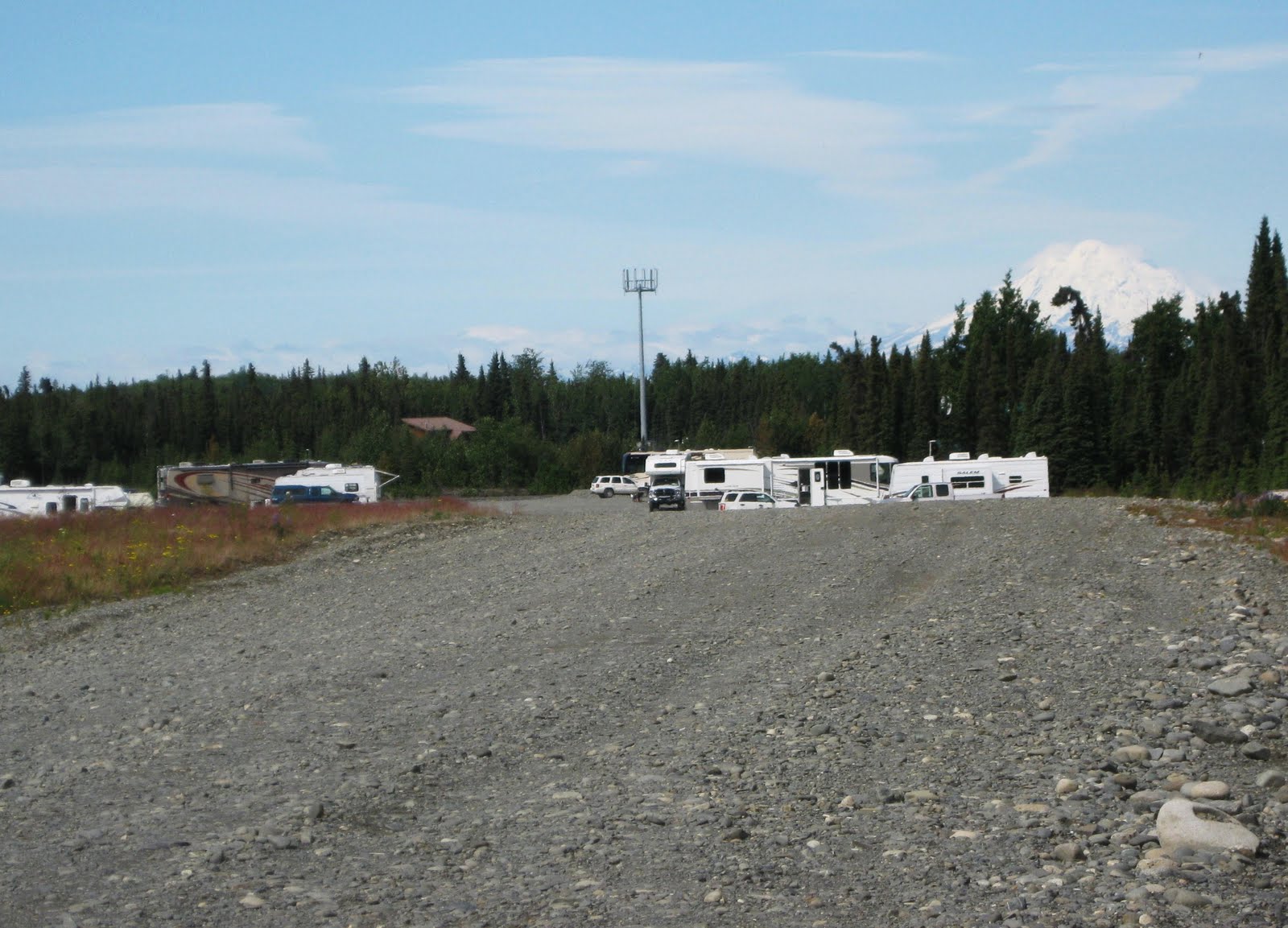
The RVs were lined up like a parking lot.  Some people had extra tents and smokers set up so that it had the feel of a hunting camp.  From the lot we could see Mount Redoubt off in the distance. We stayed here for two weeks, free of charge.


Our campsite for our two weeks on the Kenai River.

The camping lot with Mount Redoubt in the background.

David and Craig and a gazillon other fishermen lined the shore of the Kenai River and floated their hooks in an arc in front of them..... over and over and over again ..... until some unsuspecting fish got hooked. The sockeye are not looking for food, they are intent on spawning.  People call this "catching" rather than "fishing", since there is not alot of skill involved. If you snag them on their sides or fins you have to release them, but if you are lucky enough to "catch" them in or near the mouth, you can keep them.  The limit is 3 fish a day, and the experienced fishermen had no trouble catching their limit day after day after day.

David, fishing the famous Kenai River.


However, he was not alone!

On the advise of a neighboring camper, David tried fishing from a location further along the river.  There were fewer people there, so it was not so hectic. It did not take him long to land two good sized fish.

Two beauties!

While we were there, a family of four came in and landed their limit within an hour. You can see David out in the water... as they cleaned their catch.  It is difficult for me to reconcile this way of fishing.  However, knowing that the Dept. of Fish and Wildlife control the waters helps.  After all, the fish die in the end anyway.

Four fishermen catching 3 fish each equals 12 fish a day!

Our freezer was full of the halibut David caught in Homer, so we borrowed a smoker from a neighboring RVer, and smoked the last 4 sockeye that David caught. It was yummy!

David, tending to the smoker.

It smelled soooooo good!


A gourmet meal!

While we were in Soldotna we were parked next to Peg and Craig.  It was fun to share this wild and crazy fishing experience with them. Since we are full-timing in the RV, I do miss our family and  friends, so meeting up with a couple we both jived with was wonderful fun.  Peg and I had some good "girly talks" which every gal needs now and then, and the guys shared fishing stories for 2 weeks. Friendships enrich our lives, that is for sure!