Thursday, July 8, 2010

White Horses on the Yukon River


Whitehorse is the capital of the Yukon Territory and was built on the west bank of the upper reaches of the mighty Yukon river.  The city is a wonderful mix of pioneer spirit and urban sophistication. Even the modern dweller has to have a little pioneer blood to withstand the winter temperatures which have hit a record -62 degrees! 


After getting settled in at The Hi Country RV Park, David and I walked into town.  We had to walk part of the way along the main highway into town, named "Robert Service Way". Then we took the paved walkway along the Yukon River. 


There are informational displays along the walkway which help bring the local history to life.  I learned that the Yukon River is 2000 miles long!  It flows northwest from its headwaters near the Yukon Territory-British Columbia border to the Bering Sea.  One source said that some 50,000 prospectors followed the Yukon River from Lake Bennett to Dawson City during the Klondike Gold Rush of 1898-1899.


For the most part, a skilled boatsman can navigate the Yukon River relatively easily. However, the river flows through Miles Canyon and there the turbulent waters and the rapids below proved to be the major obstacles on the river.  The foaming waves reminded early travelers of tossing horse manes, and hence the name White Horse Rapids, and later, Whitehorse City.


The river walkway ended up at the Klondike paddle wheeler.  This is one of the three sternwheelers left from the 250 that served travelers between 1860 until the mid 1950's. The Klondike was the largest of the paddlewheel steamers designed to carry more cargo up and down the Yukon.  Usually it made 10-14 trips each summer, and on its last trip upriver it brought winter supplies. The Klondike overwintered in Whitehorse with the other ships. They were frozen in by mid-October and stayed that way for seven months!
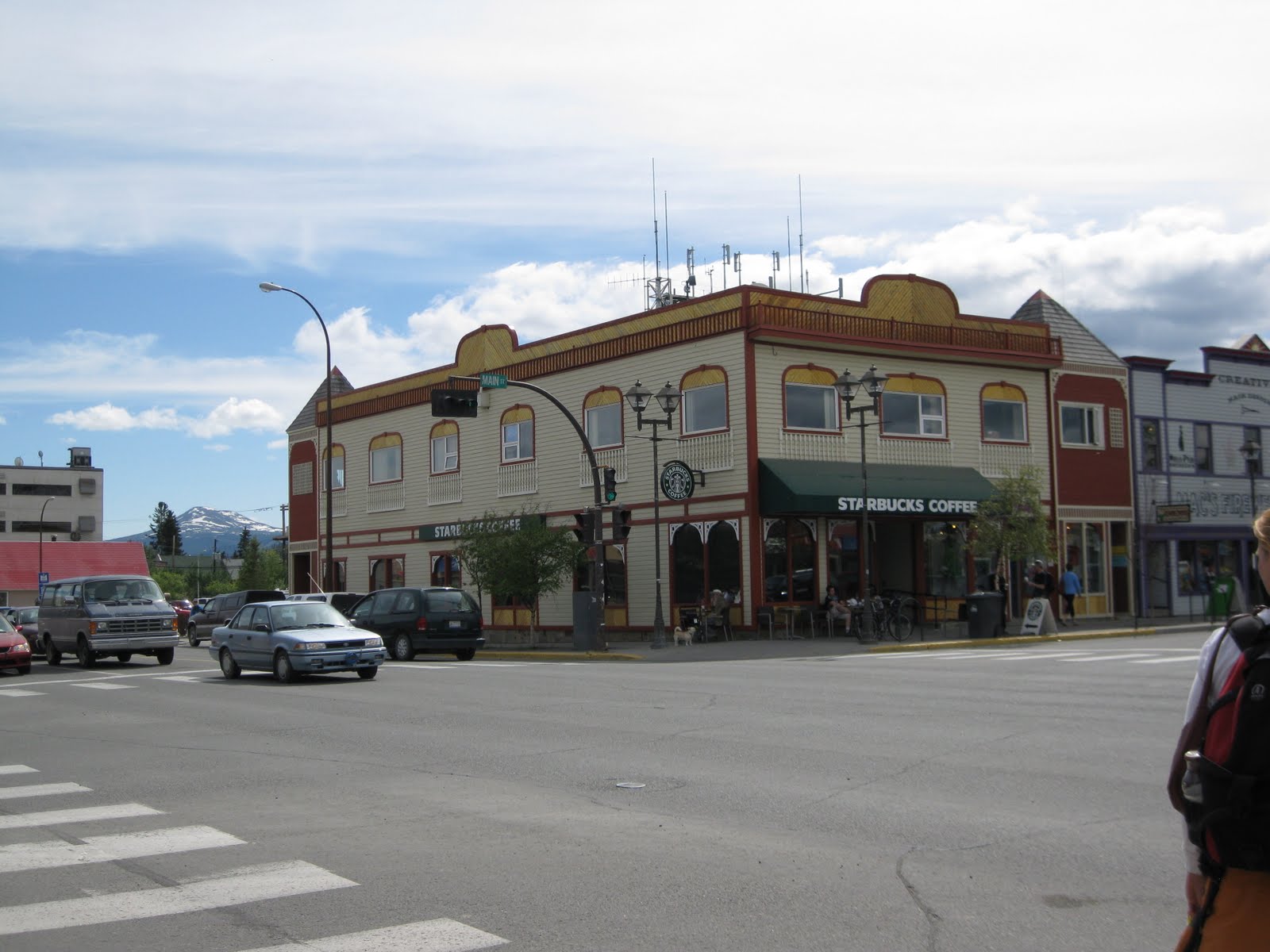

David and I wandered around town.  We visited a bookstore, took a picture of Starbucks, bought tickets for The Frantic Follies vaudeville show, and checked out the bus station so we could catch a ride back to the RV park after the show. It was fun to be in a busy town for awhile, and take in the sights.


For supper we went to The Klondike Rib and Salmon BBQ. It is such a popular restaurant that there are benches along two sides of the building where people can sit and wait for their names to be called. We split a dinner of baby back ribs and washed it down with some locally brewed Yukon Red beer....advertised as "the only beer worth freezing for". 


And, for desert we splurged on the house specialty, bumbleberry pie a' al mode.  Actually this seems to be a Yukon specialty that mixes together blackberries, raspberries, strawberries and rhubarb.  It's yummy.


We stayed in Whitehorse for five days so we both could get our Blogs set up on the computer.  That proved to be challenging for both of us.  However, it will add another dimension to our travels and we think it will enrich our experiences as we go along.

For another perspective on our travels check out David's Blog at:
                                        www.highwaytoadventure.blogspot.com


Part of the Earth - Part of the Water


Teslin has one of the largest Native populations in Yukon Territory, so our first stop was at the Teslin Tlingit Heritage Centre.  What caught our attention immediately was the row of totem poles along the entryway.


I learned that each one represents one of the tribes and one of the elements.  There is the eagle (air), frog (water), wolf (land),  beaver (water) and raven (air). We saw a video that showed the dedication ceremony and watched as the various tribes raised their totem.  It reminded me of a barn razing.  The narration proclaimed, "We are here. We take our stand." That epitomizes the deep meaning of the creation of this heritage center.

From the literature I learned that the first non-Natives to arrive in Teslin came in the 1890's with the gold rush.  In 1905 the Hudson Bay Company had a trading post in Teslin but it was not a year-round settlement until the 1940's.  Missionaries arrived of course, and in the 1930's the Russian Orthodox gave competition to the Roman Catholics.  Prayers to God replaced the prayers to nature, and the way of life for the Tlingits started to change. The advent of the Alaska Highway brought 35,000 troops into the area almost overnight.  They bulldozed trees and cut roads through the ancient lands. The Indians' traditional life was changed and the economy of the indigenous people disappeared.  It is said that the local people reacted with bewildered acceptance.  The government started sending all the 6 and 7 year old children to boarding school.  About that same time they allowed the First Nation people into the bars.  For years the Tlingit people have felt overpowered by the government. One Native woman said, "It was too much loss too fast." 

The video told the story of how traditionally the Tlingit people were in control of their lives and followed the cycles of the seasons.  "They were part of the of the earth and part of the water." "They were in touch with nature and in touch with themselves."  It was not until the 1970's that the Tlingits began a campaign for self government. At the end of the video there were words of their new cultural regeneration, to reclaim and revive the Tlingit way of life. "Once again we are in charge of our own destiny in the great circle of life."


The clan, animals, masks and stories are all very important to the Tlingit culture.  The Tlingit hostess told me that they believe that where they put their totem pole, they put their pride.


In the history of Teslin one man stands out.  George Johnson was a Tlingit Indian (1884-1982) and an entrepreneur ahead of his time. He was known for his trapping and his success as a fur trader.  He is also known for his photography.  The George Johnson Museum displays many pictures he took between 1910 and 1940 showing the life of the inland Tlingit people of Teslin and Atlin.  One of the unique stories of his life is his purchase of a 1928 Chevrolet when there were no roads in Teslin.  His car was ferried 293 miles from Whitehorse via the Yukon and Teslin rivers.  He and his friends promptly constructed a three mile stretch of road for his "Teslin Taxi".  He charged people 25 cents per mile for a ride.  In the winter he put chains on the car and drove it on the frozen lake.  His Chevy is now displayed at the museum. 


I left Teslin with the words from the video on my mind ... "part of the earth and part of the water" ... "in touch with nature and in touch with themselves."

The past three years of RV travel have brought me closer to nature than I have been since my childhood.  As an adult I have found that our modern world is so full of distractions that we often need to go away to find ourselves. My meditation practice served that purpose for years. Now I am out in nature alot.  I enjoy just sitting and soaking up the beauty and the stillness it offers. 

Once when I was sitting outside I called my daughter Cathy. When she asked me what I was doing, I replied "Watching a pine tree grow".  I know that sounds silly, but that sense of stillness and patience and awe is what puts me in touch with myself and the Mystery we call life.

Wednesday, July 7, 2010

Entering Yukon Territory


Today we drove into Yukon Territory and connected with the Alaska Highway for the first time. 
The welcome sign decribes the Yukon as "larger than life".  I believe it.


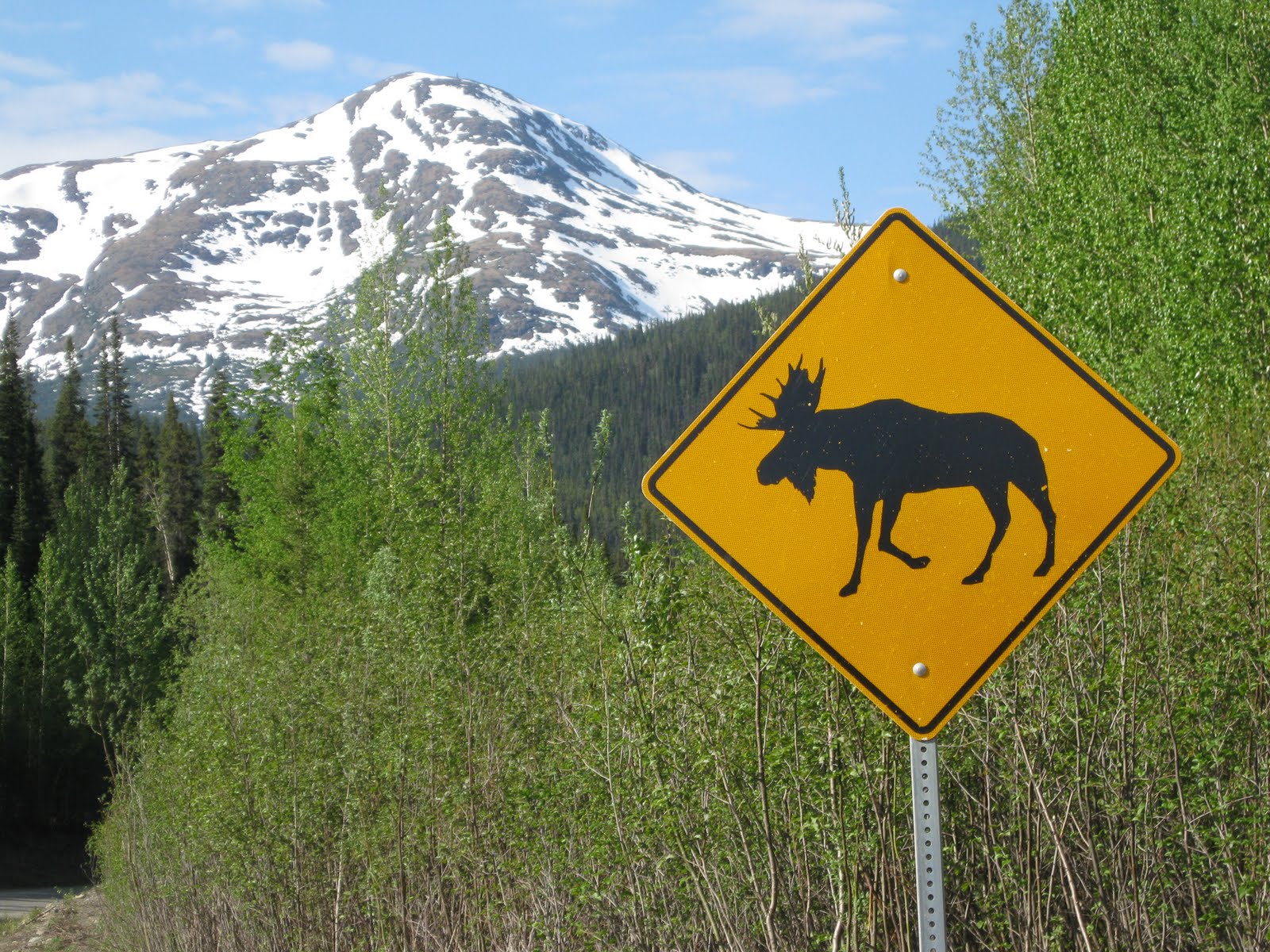
Lupine had taken the place of dandelions along the sides of the road, and the brush was cut back about thirty feet on each side to help prevent accidents with the wildlife.


My first impression of the Yukon was vastness.  The land seemed to spread out for miles in wide valleys with the ever-present backdrop of the mountains.


Soon we came to the Continental Divide. One of the information kiosks there explained that the white spruce is the most common conifer in the Yukon, and the most widely distributed.  The mature trees are 23-66 feet tall.  An average mature white spruce can produce 8,000 cones in a good year.  Each cone has 140 seeds.  Now, if we only knew exactly how many white spruce trees there are in the Yukon we could come up with a good math problem for fourth graders!


We stopped for a cup of coffee at Dawson Peaks Resort and RV Park.  David Hett and Carolyn Allen are the owners.  They have built up this establishiment on their own, first they designed and built it, and now they are serving as hosts, caretakers and chefs.  It is a very nice place.  As we entered the restaurant we met Craig and Sue from Iowa who were travelling in a 5th-wheeler.  It was Sue's birthday so we joined them for a little celebration of coffee and a some of Carolyn's famous rhurbarb pie ... a' la mode of course! 
Before we left I bought a copy of Dead North by Sue Henry, a local mystery writer. This story ends at Dawson Peaks Resort and David and Carolyn are characters in the book.  I am intrigued by stories set in the locale where I am travelling.  It makes the reading and the travelling more fun.


In the late afternoon we finally came to the overlook above the town of Teslin and the Nisutlin Bay Bridge.  We got a beautiful view of Teslin Lake and the town nestled between the lake and the Nisutlin River.  In the Tlingit language Teslin means "long narrow waters".  The lake is 886 miles long and averages two miles across.
                                                                        

That night we parked in the Teslin Lake Yukon Government Park. We had a view of the lake from our site and a path leading down to the stony beach.  From the beach we could see Dawson Peaks in the distance.   These peaks were once called Three Aces.  The Teslin people called them the "weather mountains" because the cloud formations around the peaks announced weather changes. 
The Tlingit legends tell of a time when the world was young and Animal Mother gave birth to the animals in a grassy basin high in the Three Aces.

Being in the Yukon excited me.  It felt like as if I on the edge of two civilizations, with one foot in the world of rhubarb pie a' al mode and published writers, and the other gently placed in a grassy basin high in the Three Aces listening to legends of old.
I liked the thought of "when the world was young".
I liked the thought of the Yukon being bigger than life.
I liked being here now.

Monday, July 5, 2010

B I N G O !


I have one more memory to share before we move on from Boya Lake Provincial Park. The Hosts/Caretakers of the park are Sue and Jack Chief.  Sue is a third generation Norwegian. Jack is a Kaska Indian who was born and raised on Boya Lake.  He is 72 years old now. Talking to him, I discovered that he is a good storyteller and I will try to capture a bit of his delightful manner .


Jack grew up hunting and fishing and trapping.  His family had a cabin on Boya Lake and whenever his family needed food they got it from the land.  They ate beaver, muskrat, porcupine as well as lots of fish and moose.  He told me that they used to throw a blanket over a porcupine and then pull it off in order to harvest quills.  That way they did not have to kill the porcupine if they did not need the meat, and they would have the quills for braiding baskets.

The first story Jack told me went something like this: A young friend was writing his thesis about the Kaska tribe and he lived the Sue and Jack for most of one winter.  The young man wanted to hunt and trap and experience the life of a Native.  Jack taught him various skills. One day they caught a muskrat and the young man thought it was a beaver and was all excited about his catch.  Jack went along with him and said it was the smallest beaver he had ever seen...  maybe even a record catch.  The young man took the muskrat back to the house and Sue cooked it for supper, never letting on that it was not a beaver. They enjoyed that joke for a long time before letting on to the young man.


According to Jack, humor is a big part of Native life.  He said if he fell off his ATV or if he stumbled over a rock or a tree root, Sue would laugh.  When she started doing that he told her she was "becoming too Native".

The Milepost notes a creek not far from Boya Lake called "Charlie Chief Creek".  Jack told me it was named for his father. Then he went on to tell a story about his father. "Charlie went to the casino in Terrace to play Bingo and he won. We won a brand new Chevrolet truck!  Charlie called home to get a grandson to come pick him up and drive the truck back.  After that Charlie liked to have his grandsons drive him all over while he sat in the passenger's seat and smiled."

Jack said that his father used to walk miles everyday.  However, "after he got that truck he lost his legs."  Nevertheless, Charlie Chief won big at Bingo and died a happy man at the age of 97. 


Saturday, June 26, 2010

Moose Hunting


Although the fishing was lousy on Boya Lake, the kayaking was so fantastic that we decided to stay on a little longer. The camp hosts, Sue and Jack Chief, told us that there was a mother moose and her calf living on the islands across from where we camped.  That was good enough reason to stick around.  After driving for over a month, I had seen only one moose and hundreds of pictures of moose.


The water was as smooth as glass as we headed over to the islands.  We paddled in and around the islands looking for signs of moose and listening for movement in the underbrush.  It is amazing how many times I mistook dark trees or shadows for wildlife.  My mind was playing tricks on me.


Finally we heard crashing sounds in the woods.  We stopped and waited.  Soon we saw shadows moving in the dense foliage and moments later a cow moose stepped out into the water with her calf close behind.


The mother and baby swam to the next island as David and I frantically took as many photographs as we could.  Then we followed them along to the next island, catching glimpses of them as they browsed and occasionally looked up at us. 

                                                      
Moose are very dangerous animals and mothers are especially protective of their young.  However, this moose did not seem frightened or defensive at all.  Maybe she was not sure what we were, floating around in our yellow kayaks, or perhaps she just felt safe in these islands where she comes each Spring to have her calves. 


That night we were still talking about our adventure.  We couldn't wait to tell Sue and Jack Chief about the moose hunt. At 10:30 pm as the sun was setting, the snow on the mountains across the lake took on a pinkish color which was reflected in the mirror surface of the lake.  The world was still.  Mother Nature was tucking us in for the night.

For another look at Boya Lake, check out my husband's blog at:
                http://www.highwaytoadventure.blogspot.com/


Location - Location - Location


When we landed at Boya Lake Provincial Park, we knew we had found the ultimate real estate deal. 
 For only $16.00 CND  a night, we settled in for a few days of beauty and adventure. 


After we found our campsite, it did not take us long to get the boats on the water to go exploring. 


The many little islands across the lake beckoned to us and made kayaking alot of  fun. We discovered  beaver dams that connected two of the small islands, and found a huge beaver lodge close by....but no beavers!


We also explored the park a little by foot.  We discovered the hard way that the nature trail leading to the beaver dams was mostly under water, so we decided to hike along the lake shore trail instead. An informative kiosk at the trailhead describes the local flowers and how the Native Peoples used them. For example, "The Native People recognized eight different varieties of Saskatoon.  The berries were a very important food scource for all the interior peoples.  The berries were eaten fresh or dried in cakes or like raisins for storage." That sounded like a good addition to our trailmix.


The trail was easy walking and was often lined with lupine or aspen trees, or both.


Every once in awhile the path opens up to small coves.  Each one was an invitation to take a picture....


and another...


What a place! What a day!  It doesn't get much better than this!


The Color of Jade


Our first stop the next day was Jade City.  The Milespost  describes Jade City as "not so much a city as a collection of homes and shops connected with the jade business."


We went into the Cassiar Mountain Jade Store to look around.  Out in front there were stone saws and examples of quarried jade. I wet the edge of one piece to see how it will look when it is polished. 


The owner of the shop was very friendly and seemed to enjoy talking to us. His family has mined and designed jade here for over 30 years. We had no idea the the Cassiar Mountain Range in BC supplies 92% of the world's jade market.  Most of that comes from The Princess Mines.  We were told that a New Zealand miner works here in the summer and takes 100 tons of jade back home with him every year.  He can buy one kilo of jade here for $20.00 and sell it for $80.00 a kilo back in New Zealand.  (Although jade is mined in New Zealand, by law only the Maoris can trade in it.)  I asked about the jade business in China, and was told that they have not mined jade there since the early 1980's.  Representatives from China come to BC to buy hunks of jade. They ship it to China where it is carved and then many of the finished pieces come back and are sold right here in this shop! There was a large piece of jade by the entry that weighed in at 15 tons, and came up to my shoulders.  It gave me an idea of what 100 tons of jade would look like.


Of course our conversation covered a little politics.  This entrepreneur was frustrated by what he referred to as "the Indian problem".  The BC government would subsidize his business if he hired an Indian.  However, in his experience the Indian's "don't like to work".  According to him all the tribes are subsidized by the government, but the money is given to the headmen and often only their families profit from it.  He claimed that the Natives do not pay any taxes, and all of them are given free medical and dental care, welfare whenever they need it and old age pensions whether they ever worked or not. 
If that all is true, then I guess I'd call it a problem. too.


And, we talked weather.  We have been pleasantly surprised by the warm and even hot days and the very cold nights.  We were told that because this has been a dry winter the bugs are not bad, and as long as the nights are cold, their numbers will stay down.  That morning the temperature was already 73 degrees although it had been down below freezing that night. Jade City gets only 21 frost free days a year!  Their summer is short, but during that time this store makes 98% of its income. 
Seems like the tourist business is just as lucrative as the mining business.


Our day ended at Boya Lake Provincial Park, the last provincial park along The Cassiar Highway.
It is a glacial lake, crystal clear and azure in color. Along the shallow shorelines it is ... the color of jade.